Skill-75/2024
23 August 2024
Established the Composite Skill Lab requirement and specified the 600 sq. ft. single-lab / 400 + 400 sq. ft. two-lab options.
View Circular Skill-75/2024 (PDF)
Design. Equipment. Installation. Training. Support.
Create a hands-on learning environment for AI, Coding, Electronics, EV, Green Skills and emerging technologies—designed around your school's space, curriculum and implementation needs.
TRUSTED EXPERIENCE. PROVEN IMPLEMENTATION.
Ref: Skill-75/2024 · Skill-13/2026
CBSE has mandated the establishment of Composite Skill Labs in affiliated schools through Circular Skill-75/2024 and the subsequent Skill-13/2026 guidelines.
Existing CBSE-affiliated schools must establish the required Composite Skill Lab by 22 August 2027. Schools seeking fresh affiliation must meet the applicable lab requirement as part of the affiliation process.
This is more than a compliance requirement.
Composite Skill Labs provide students with dedicated environments for hands-on, practical and activity-based skill learning.
SkyySkill Labs helps schools move from planning to implementation with a complete Composite Skill Lab solution—covering space planning, lab design, equipment, installation, curriculum alignment, teacher training and post-installation support.
A hands-on learning environment where students learn by building, experimenting and solving real-world problems.
A Composite Skill Lab (CSL) is a flexible, multi-sector learning environment where students gain practical experience through hands-on activities, projects and experimentation.
Instead of separating every skill area into a different laboratory, a Composite Skill Lab brings multiple skill domains into a shared, well-organised space—helping students connect what they learn in the classroom with how it is applied in the real world.
CBSE's own 2026 guidelines describe the CSL as a critical infrastructure for hands-on, activity-based learning and emphasise accessibility, safety and adaptability.
Concepts
Understand concepts in the classroom.
Projects
Apply concepts through practical activities and projects.
Solutions
Solve problems, experiment and develop real-world skills.
Key references: Skill-75/2024 and Skill-13/2026
CBSE introduced the Composite Skill Lab requirement through Circular Skill-75/2024 and subsequently issued detailed establishment guidelines through Skill-13/2026.
23 August 2024
Established the Composite Skill Lab requirement and specified the 600 sq. ft. single-lab / 400 + 400 sq. ft. two-lab options.
View Circular Skill-75/2024 (PDF)20 March 2026
Issued detailed Composite Skill Lab guidelines—whose tool and equipment lists are suggestive and can be adapted to each school—and confirmed 22 August 2027 as the deadline for existing affiliated schools.
View Circular Skill-13/2026 (PDF)Let our team assess your space, skill requirements and implementation needs.
CBSE does not prescribe a fixed set of sectors — Circular Skill-75/2024 asks schools to offer at least one skill subject and to add more choices over time. Pick the sectors that match your students' interests, your teachers and your space; the table below shows what each one involves.
| Sector | What students learn | Key equipment |
|---|---|---|
Automotive | Vehicle servicing, EV diagnostics, battery management systems, automotive electronics, and hybrid powertrain fundamentals. | EV training kits, battery analyzer, OBD-II scanner, multimeter, automotive wiring harness trainer |
IT/ITeS | Coding fundamentals, web development, cybersecurity basics, cloud computing concepts, and AI/ML introduction. | Computers with development IDEs, networking equipment, Raspberry Pi kits, IoT sensor modules |
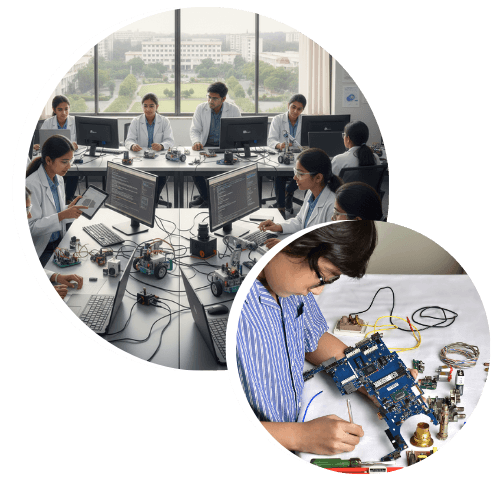
Electronics & Hardware | Circuit design, PCB fabrication, embedded systems, solar energy systems, and IoT prototyping. | Arduino and ESP32 kits, Oscilloscope, soldering station, breadboards, component kits, multimeters |
Beauty & Wellness | Skincare science, hair care techniques, wellness therapy basics, aromatherapy, and personal grooming standards. | Mannequin heads, skincare product kits, basic salon equipment, wellness therapy tools |
Healthcare | First aid and CPR, basic patient care, medical device awareness, health monitoring instruments, and hygiene protocols. | CPR mannequin, first aid kits, BP monitor, stethoscope, pulse oximeter, glucometer |
Agriculture | Soil testing, hydroponics, drone-based crop monitoring, organic farming methods, and agricultural IoT systems. | Soil testing kit, hydroponic setup, pH meter, drone for aerial survey, irrigation controller |
Retail | Point-of-sale systems, inventory management, visual merchandising, customer relationship management, and e-commerce basics. | POS terminal trainer, barcode scanners, inventory management software, merchandising display units |
Tourism & Hospitality | Front office operations, food safety and hygiene, travel planning, event management, and customer service excellence. | POS system, front desk simulation setup, food safety kits, event planning software |
BFSI | Financial literacy, digital banking, insurance fundamentals, basic accounting, and fintech tools. | Computers with accounting software (Tally), currency counting machine, banking simulation software |
Telecom | Networking fundamentals, fiber optic splicing, 5G technology basics, tower equipment awareness, and signal measurement. | Fiber optic splicing kit, cable tester, network simulator, signal meter, STP/UTP cables |
Media & Entertainment | Video production, audio editing, graphic design, animation basics, and social media content creation. | DSLR camera, tripod, green screen, audio recorder, computers with Adobe Creative Suite |
Apparel, Made-Ups & Home Furnishing | Fabric identification, basic tailoring, pattern making, textile quality testing, and fashion design fundamentals. | Sewing machines, fabric testing kits, pattern drafting tools, cutting table, mannequins |
Plumbing | Pipe fitting, sanitary installation, water supply systems, drainage systems, and solar water heater setup. | Pipe threading machine, pipe cutter, plumbing tool kit, sanitary fitting models, pipe bending machine |
The CBSE circulars set the floor area. Everything else here is our engineering recommendation from past installations — check it against CBSE's skill education guidelines for your school.
Option A · Single lab
One shared lab for Classes VI–XII
Option B · Two labs
Separate labs for Classes VI–X and XI–XII
Not CBSE rules — the room conditions we recommend so equipment runs safely and lasts.
Minimum 10 ft for ventilation and equipment clearance
Three-phase connection with adequate load capacity for CNC, 3D printers, and lab equipment
Broadband with minimum 50 Mbps for IT/ITeS, IoT, and digital learning tools
Fire extinguishers, first aid kit, clearly marked emergency exits, ESD-safe workstations
Adequate ventilation or AC for electronics and healthcare equipment longevity
Lockable cabinets for equipment, chemical storage (healthcare), and raw material storage
A seamless, end-to-end journey to get your lab up and running
Our team visits your school to evaluate available space, power supply, and infrastructure readiness.
We create a detailed floor plan with sector-wise zoning, equipment placement, and safety provisions.
We source and supply certified equipment for the sectors you choose, including import items where needed.
Professional installation of all equipment with wiring, networking, and calibration.
We map lab activities to CBSE's prescribed curriculum for each class level (6-12).
Hands-on training for your staff covering equipment operation, experiment protocols, and safety procedures.
We hand over layout drawings, equipment lists and specifications for your school's records and CBSE affiliation paperwork.
Lab handover with ongoing maintenance and support agreement.
End-to-end Composite Skill Lab setup, from site assessment to handover
Proven track record across schools and institutions nationwide.
Collaborations with IIT Bhubaneswar and other premier institutions for curriculum design and equipment validation.
Equipment packages for all 13 sectors listed above, from EV kits to healthcare training modules, so you can choose the sectors that fit your school.
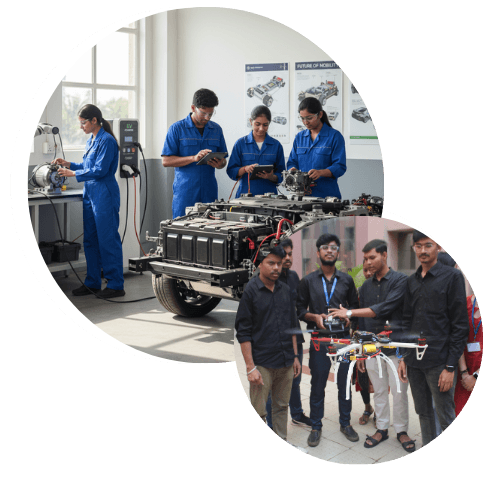
Industry-leading expertise in Automotive (EV), Agriculture (Drones), and Electronics (Solar) — high-impact sectors for student engagement.
Lab design, equipment procurement, installation, curriculum mapping, teacher training, and annual maintenance.
We design lab layouts optimized for your available space (600 sq ft or 2 x 400 sq ft) with zoning for different sectors.
Ongoing maintenance, equipment upgrades, and refresher training for teaching staff.
Planning more than a skill lab? See our EV Lab and Drone Lab setups, or browse our equipment catalogue on IndiaMART.
Contact us for a customized quotation tailored to your specific infrastructure and needs.
Want to learn more? Read our blog on CBSE Composite Skill Labs.
Everything you need to know about setting up a CBSE Composite Skill Lab
A Composite Skill Lab (CSL) is a dedicated practical space where students of Classes VI–XII learn CBSE skill subjects hands-on. CBSE introduced it through Circular Skill-75/2024 and restated it in Circular Skill-13/2026. It needs 600 sq ft, or two labs of 400 sq ft each — one for Classes VI–X and one for Classes XI–XII.
Circular Skill-75/2024, dated 23 August 2024, mandated that all CBSE-affiliated schools establish a Composite Skill Lab with all necessary equipment and machinery. Circular Skill-13/2026, dated 20 March 2026, restated the requirement, confirmed the 22 August 2027 deadline for already-affiliated schools, and referred schools to CBSE's guidelines booklet.
Schools already affiliated with CBSE must establish their Composite Skill Lab by 22 August 2027 — three years from Circular Skill-75/2024, as confirmed in Circular Skill-13/2026. Schools seeking fresh affiliation get no grace period: a fully equipped Composite Skill Lab is a mandatory requirement at the time of applying.
Neither circular requires a fixed number of sectors, and neither lists thirteen mandatory ones. Circular Skill-75/2024 advises schools not yet offering a skill subject to offer at least one, and schools already offering skill subjects to add more choices. The 13 sectors on this page are common options to choose from, not a requirement.
CBSE specifies either one Composite Skill Lab of 600 sq ft for Classes VI–XII, or two separate labs of 400 sq ft each — one for Classes VI–X and the other for Classes XI–XII. Floor area is the figure set in the circulars; CBSE's guidelines booklet covers further infrastructure and safety norms.
Yes. Circular Skill-75/2024 says all schools affiliated with CBSE must establish a Composite Skill Lab. It is a mandatory requirement for fresh affiliation, and already-affiliated schools must have one by 22 August 2027. Neither circular specifies a penalty for missing the deadline.
Neither CBSE circular mentions Atal Tinkering Labs. An ATL's electronics, robotics and 3D-printing equipment can support related skill subjects, but the circulars still call for a Composite Skill Lab of 600 sq ft (or two labs of 400 sq ft) equipped for your chosen skill subjects. Confirm any shared-room plan with your CBSE regional office.
Equipment depends on the sectors your school chooses. CBSE describes the tool and equipment lists in its guidelines as suggestive, to be adopted based on each school's readiness. Typical items include EV training kits, Arduino/ESP32 modules, 3D printers, oscilloscopes, soil testing kits, CPR mannequins, sewing machines, POS terminals and networking equipment.
Cost depends on the number of sectors you choose, whether you build one 600 sq ft lab or two 400 sq ft labs, and what equipment your school already has. SkyySkill Labs prepares a quotation after a site assessment, so the figure reflects your actual room and sector mix. Contact us for a customised quotation.
Yes. SkyySkill Labs offers end-to-end Composite Skill Lab setup including lab design, equipment procurement, installation, curriculum alignment, teacher training, and ongoing maintenance support. We have completed 65+ lab deployments across India in partnership with institutions like IIT Bhubaneswar.
Yes. We provide teacher training covering equipment operation, experiment protocols, safety procedures, and pedagogical approaches for each sector your school chooses. Training can be conducted on-site or through our digital learning platform.